

Manual Handling Regulations Guide – Navigating the Jungle of Safe Lifting Rules and Ergonomic Risk Assessments
When it comes to manual handling regulations, have you, too, tried to find answers to apparent simple questions like:
- What are the weight limits for lifting and carrying objects in the workplace in my country?
- What do I as an employer need to be aware of (what are my legal responsibilities) when my employees engage in manual handling of loads?
... but despite all your efforts you failed to find anything concrete, relevant or useful?
... or drowned in information overload from long-winded academic documents or dry, non-concrete paragraphs in ‘legalese’?
... or simply just threw in the towel because of the complexity of what you found?
… then you’re not alone!
We too, find this jungle of directives, rules and regulations chaotic, unclear and complicated, which is why we have decided to write these pages.
- We want to help you!
- We want to make it easier for you to find what you need and to understand the rules!
- We want to contribute our part in helping to bring down the large number MSD (Musculoskeletal disorder) incidents that apparently continue to rise in Europe (perhaps also worldwide) despite the existence of and efforts to implement manual handling regulations. (reference)
Therefore, this section of our website is dedicated to providing free and hopefully helpful information on the directives, standards and regulations on the manual handling of loads and the recommended ergonomic assessments and tools related to lifting and carrying.
This particular page is the ‘mother’ page of this section.
The purpose on this page is twofold and what you get is:
1) An Overview of the Regulations of Manual Handling in the U.S. and EU!
We will provide you with a model that shows you how everything (organisations, legislations, guidelines etc.) is related to each other. Hopefully this overview will help you pinpoint which organization / legislation / directive you need to know more about and get information from.
2) A Navigation Guide to Help You Find Exactly What You Need!
We will link out to two types of pages:
- Pages with in-depth information on a certain topic or organization
- Pages with information on and links out to national guidelines for manual handling (so far we have obtained information for the U.S., Canada, Australia, UK, Ireland, Denmark, Sweden, Norway, Germany, Holland / The Netherlands, France, Spain, Portugal, Switzerland, Austria and Italy)


For now, let's get started with the above point number 1:
An Overview of the Regulations of Manual Handling in the U.S. and EU!
The Workings of Manual Handling Regulations in the U.S. and EU
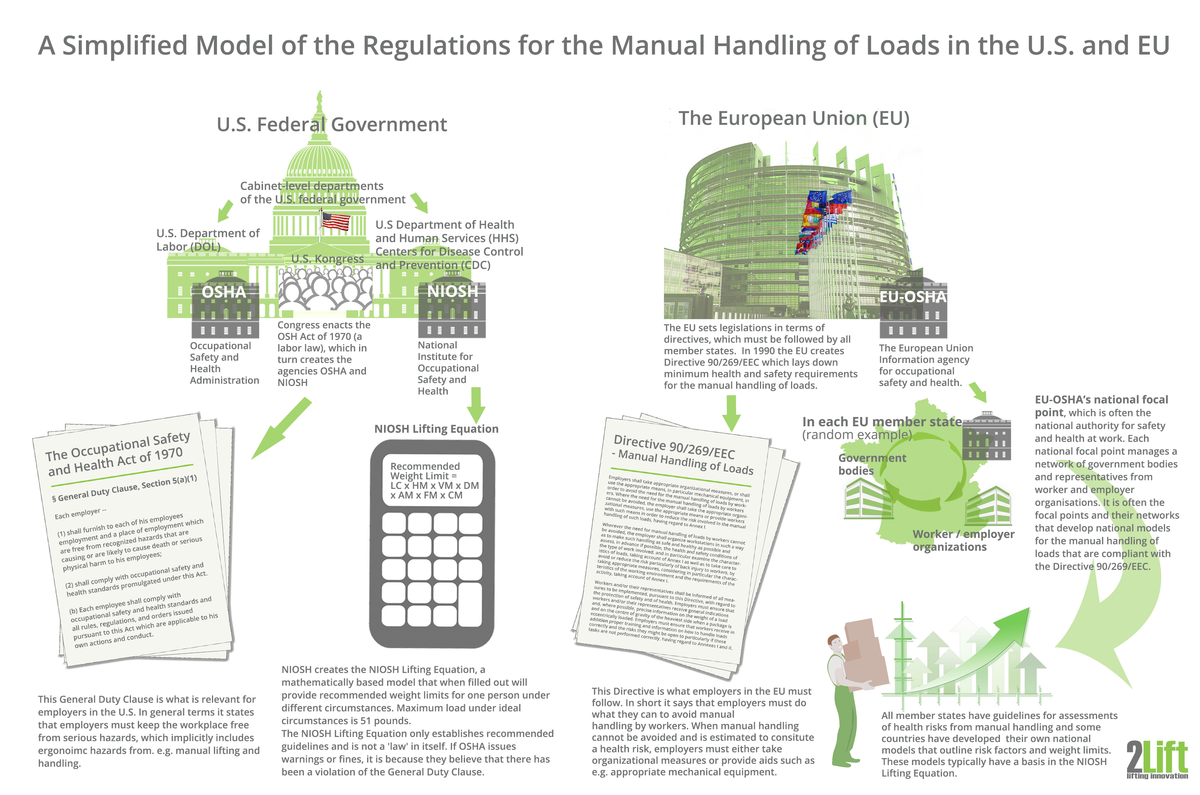
Basically, what the above model shows is that the overall regulations for the manual handling of loads are fairly similar in the U.S. and EU.
In the U.S. we have the labor law called The Occupational Safety and Health Act of 1970 (also called the OSH Act), and in the EU we have Directive 90/269EEC which has to be followed. (Canada, Australia, and other countries with clearly established manual handling regulations, we’re sorry we didn’t include you in the above model, but we do have separate section for you to explore further down this page.)
In general terms, these U.S. and EU regulations say that:
- It’s illegal for an employer to put the physical health of their employees at risk.
- It’s the responsibility of the employer to identify physical risks (perform ergonomic risk assessments) and eliminate them, either by completely removing the need for manual handling or to provide the means to make handling actions safe e.g. via ergonomic mechanical aids.
Those are the words in broad terms.
All this is very well, but as you may have noticed, not very applicable in practice.
You see, none of these regulations provide any concrete guidelines in terms of e.g. lifting guidelines or weight limits for lifting and carrying. So in themselves, these laws are not very useful for an employer looking for concrete facts about weight limits and what to do about them.
So where can you go to find more specific information?
Well, the kind of material applicable to you (ergonomic guidelines to follow, manual lifting calculators to use etc.) depends on where you live – which state in the U.S., which country in the EU.
Therefore we encourage you, all depending on your level of interest in this subject, to read on or scroll down this page, until you find a link to your subject of interest or your country of origin.
For now, let’s go through how the manual handling regulations work in the U.S.
Manual Handling Regulations in the U.S.
When it comes to manual handling in the U.S., you’ve got to know a little bit about OSHA.
OSHA (Occupational Safety and Health Administration) is a national public health agency, which is part of the United States Department of Labor.
OSHA is in some ways the ‘manual handling police’ in the U.S. They are responsible for ensuring that employers keep their employees safe at work. They do this by setting standards, enforcing them and providing training and education (reference).
In the U.S. there are two types of safety and health programs a state can follow:
- They can follow their own program (which has to be approved by OSHA, though)
- Or they can follow the ‘general’ one called the Federal OSHA program.
In the U.S., each state is actually encouraged by the OSH Act to make their own state plans. Some states have done this, some haven’t. You can follow this link to find out whether or not your state has a state plan.
If a state doesn’t have a state plan, then they then must follow the Federal OSHA program.
However, and this is important:
OSHA doesn’t have any official regulations on the limits on how much a person may lift or carry! (reference)
So what do you do then?
Well, even though there aren’t any official rules in terms of weight limits, there are guidelines and ergonomic assessment sheets and tools that are created to help prevent accidents, injuries and MSD.
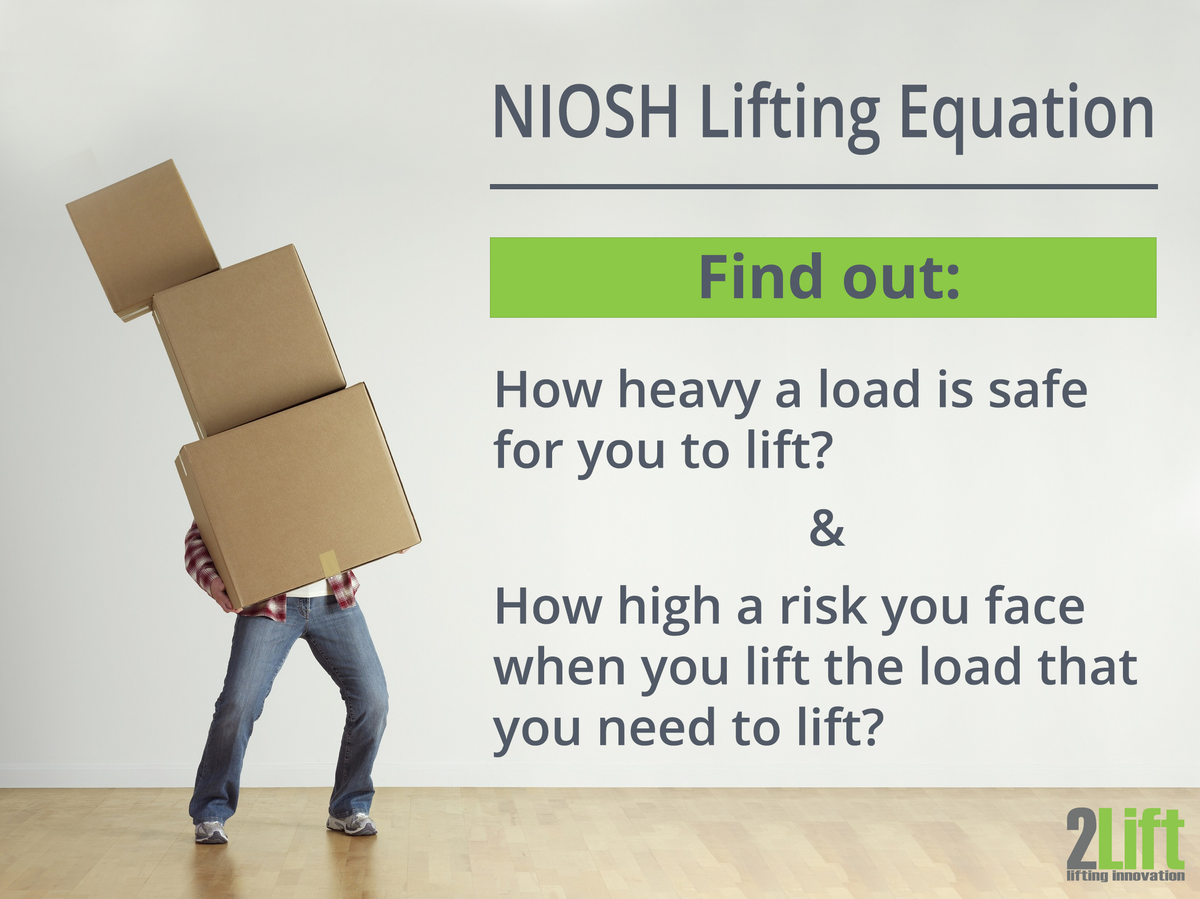
The NIOSH Lifting Equation
– The Main Manual Handling Ergonomic Risk Assessment Tool
Thus in an effort to provide more concrete help with how much a person must lift and carry at work, OSHA’s agency ‘sister’, NIOSH (National Institute for Occupational Safety and Health), has created a math based lifting formula called the NIOSH Lifting Equation.
However, the NIOSH Lifting Equation is rather technical to use. It’s not enough to just feed it a number or two and then it spits out a result. You need to put in all the variables (and there are many) to the specific lifting action. If you’re a math lover, it’s heaven. If you’re not, it’s well, not so heavenly.
Anyway, what this NIOSH Lifting Equation does, is that it establishes the maximum load under ideal circumstances to be 51 pound (roughly 23 kilos). And then all depending on the circumstances making the lifting action more strenuous and risky, the recommended weight of the load is then reduced (that’s what all the variables are for).
But again, the weight limits that you get when using this equation are only recommendations by NIOSH. They are guidelines only. Not the law.
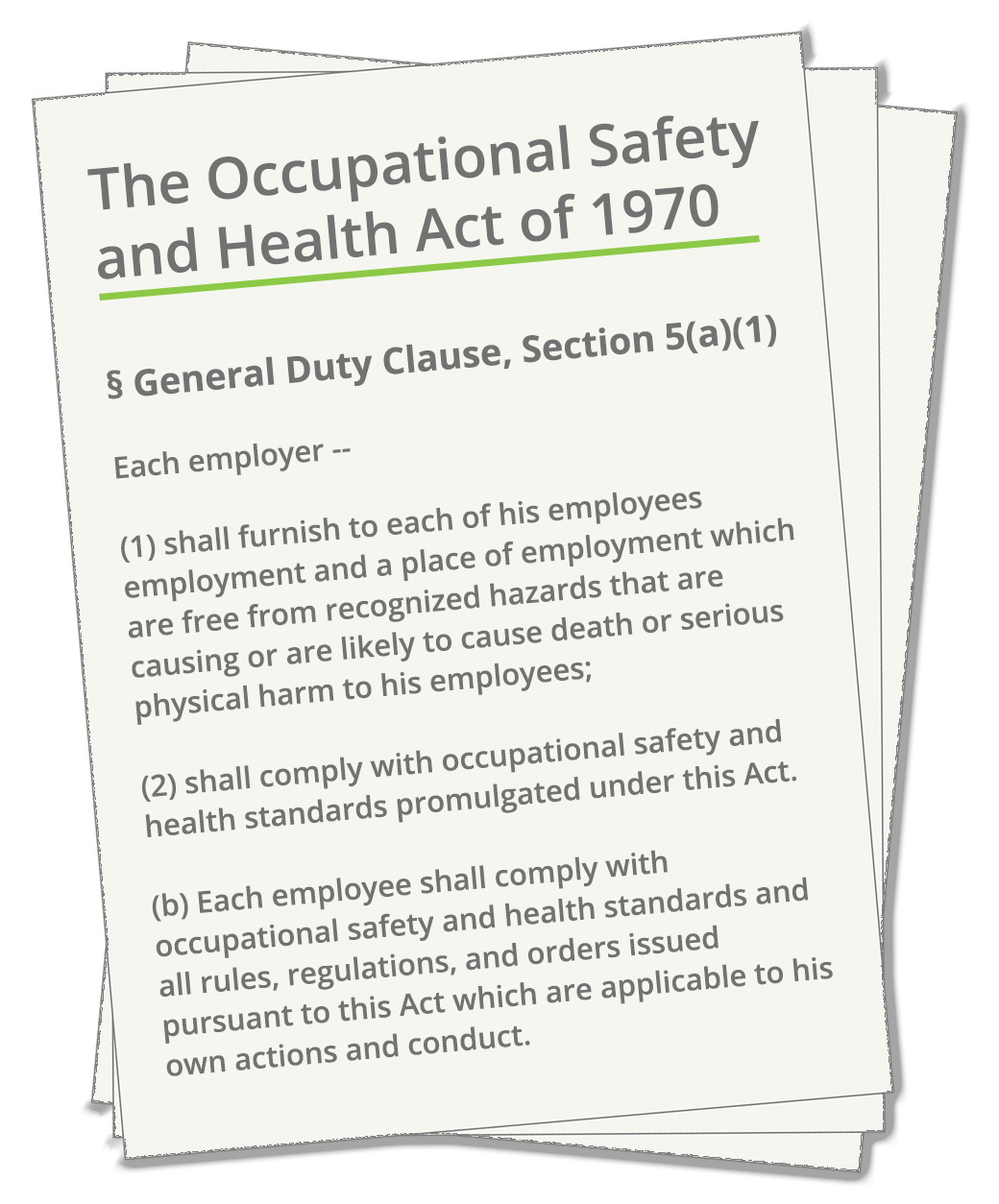
The law that you have to follow is the general one, the The Occupational Safety and Health Act of 1970 and more specifically the General Duty Clause, Section 5(a)(1), which states that:
Each employer —
(1) shall furnish to each of his employees employment and a place of employment which are free from recognized hazards that are causing or are likely to cause death or serious physical harm to his employees;
(2) shall comply with occupational safety and health standards promulgated under this Act.
(b) Each employee shall comply with occupational safety and health standards and all rules, regulations, and orders issued pursuant to this Act which are applicable to his own actions and conduct.
So even though there aren’t any specific rules to follow, you have to follow the overall law. As OSHA themselves states:
“Even if there are no guidelines specific to your industry, as an employer you still have an obligation under the General Duty Clause, Section 5(a)(1) to keep your workplace free from recognized serious hazards, including ergonomic hazards. OSHA will cite for ergonomic hazards under the General Duty Clause or issue ergonomic hazard alert letters, where appropriate, as part of its overall enforcement program. OSHA encourages employers to implement effective programs or other measures to reduce ergonomic hazards and associated MSDs.”
To perform your own ergonomic risk assessment for manual handling operations in order to discover:
- whether or not what you need to lift is too heavy
- or to find the maximum weight limit for a certain lifting task
… you can explore either our NIOSH Lifting Equation page or our Lifting Calculators page to find a link to the exact tool that is right for you.
OSHA Link Library on Ergonomics and Manual Handling

If you want more information on manual handling from OSHA, you can follow these links and read more about:
- Ergonomics, MSD and lifting hazards
- Heavy Lifting
- Pushing, Pulling and Carrying
- OSHA Proper Lifting Techniques: Safe Lifting Ergonomics
- An employer / employee guide on Material Handling and Storing
- OSHA’s free poster that informs workers of their rights under the OSH Act.
Our Resources on Ergonomic Assessment Tools for Manual Handling in the U.S.
Also, we have created the following ergonomic resources below for those interested in manual handling risk assessment tools from the U.S.
Individual state agencies’ and other parties’ ergonomic assessment models for manual handling: Ergonomic calculators for employers and workers to evaluate risks and maximum loads for manual lifting.
See our varied range of flexible, strong, and ergonomic industrial material handling machinery ideal for any type of storage environment in any type of industry.
Manual Handling Regulations in the EU
In the EU it’s all about Directives, especially the ‘Manual Handling Directive’ (90/269/EEC).
In Europe we have the EU which sets legislations in terms of directives. These directives must be followed by all member states.
In 1990 the EU creates Directive 90/269/EEC which lays down the general minimum health and safety requirements for the manual handling of loads. (Directive 90/269/EEC is one of five individual directives that come under the overall Framework Directive 89/391 of 1989 created with the intention of protecting workers and improving their health and safety at work.)
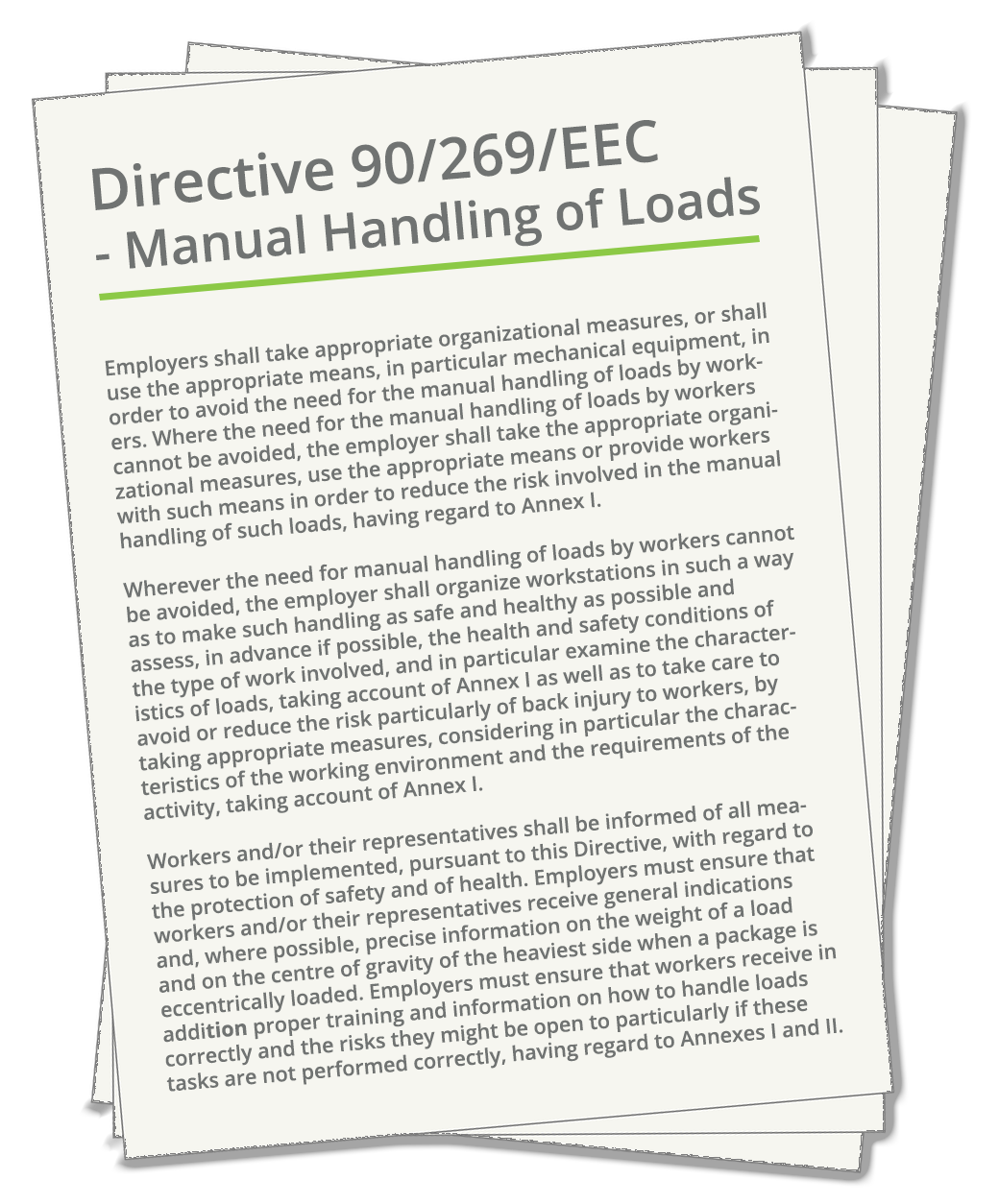
Among other things, Directive 90/269/EEC (also called the Manual Handling Directive) states that,
“Employers shall take appropriate organizational measures, or shall use the appropriate means, in particular mechanical equipment, in order to avoid the need for the manual handling of loads by workers. Where the need for the manual handling of loads by workers cannot be avoided, the employer shall take the appropriate organizational measures, use the appropriate means or provide workers with such means in order to reduce the risk involved in the manual handling of such loads, having regard to Annex I.”
OSHA Also Plays an Important Role in Europe
Just like what is the case in the U.S., in the EU there is also an important OSHA presence. Here, it’s called EU-OSHA (The European Union Information Agency for Occupational Safety and Health.
EU-OSHA has what’s called a ‘national focal point‘ in each EU member state. This national focal point (often being the national authority of health and safety at work) and its national network (government bodies and representatives from worker and employer organisations) are responsible for developing national guidelines and models for communicating the manual handling regulations for the public in their respective country.
In the EU all member states must be able to publicly present guidelines for performing risk assessment for manual handling. A few countries have chosen to include specific weight limits to the material handling of loads in their national legislation, others have not. Most models built have a basis in the NIOSH Lifting Equation.
The way that each EU country have chosen to work with the Directive and how they have chosen to present it to their national audience is very different from country to country. Some have put a lot of work into building lots of easily accessible and easy-to-understand material for the public, others seemingly not. Member states had until December 31, 1992 to create laws, regulations and administrative provisions needed to comply with the Directive 90/269/EEC.
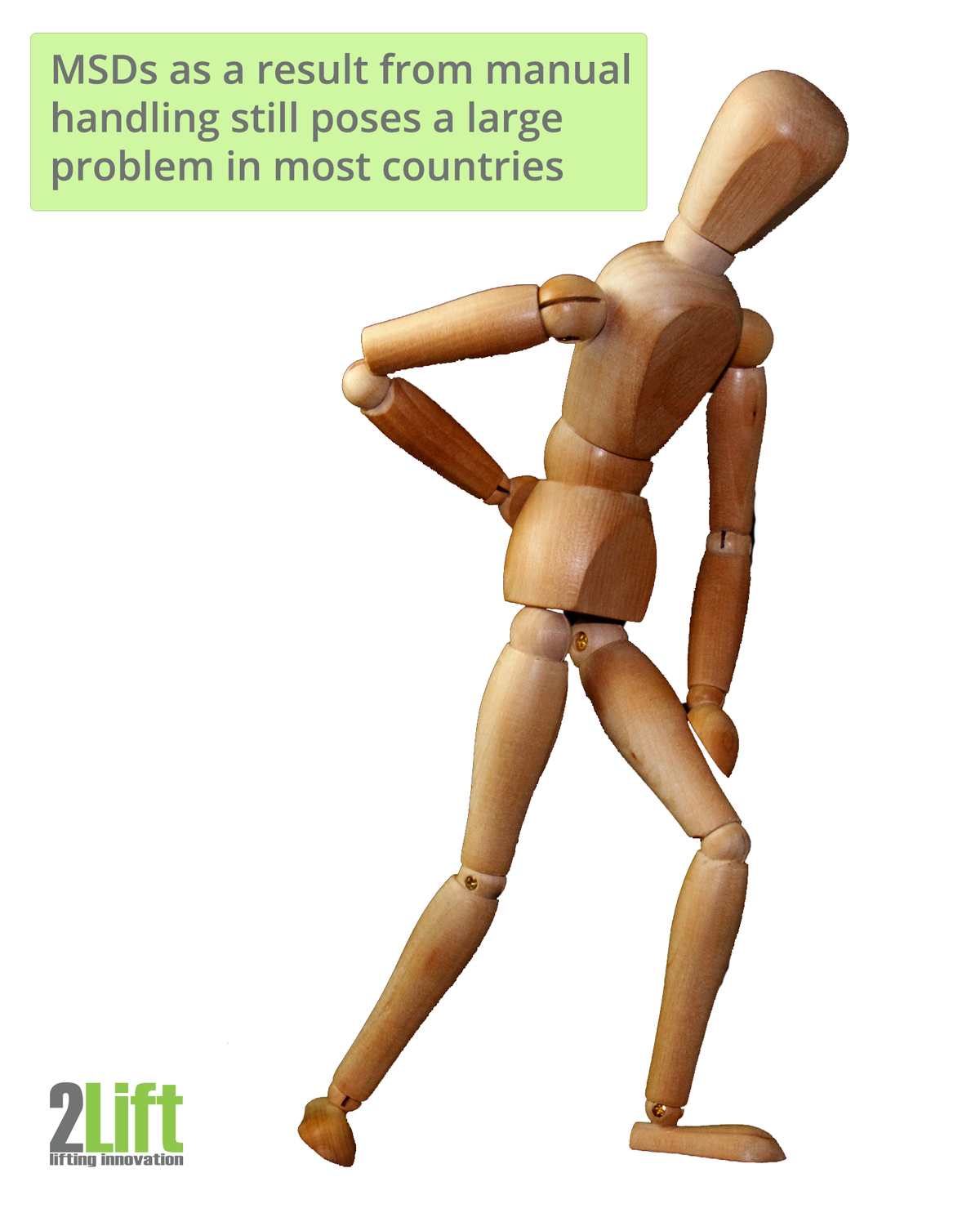
Implementing the ‘Manual Handling Directive’ Has not Been a Simple Walk in the Park ... MSDs Are Still a Growing Trend in Many Countries
The implementation and enforcement of all these directives for safety and health at work, has not been all that easy, however. Challenges have been especially prominent in the southern parts of Europe.
Broadly speaking, even though employers’ awareness of the necessity of having to abide by the rules for the manual handling of loads and despite the initiative to take preventive measures has risen since the rules were made, the number of workers suffering from back related problems like MSD is not showing a diminishing trend.
In many countries the trend is growing. And rather surprisingly, the number of employees who have to deal with loads manually, is also growing. All this quite opposite to the intention of the directive.
In other words, even though employers know there are rules for lifting, carrying and handling – for some reason, they seem to be not following them. This problem is especially critical in small to medium sized corporations where obligatory risk assessments and proper workers’ training still fail to be carried out.
Investigations of this problem have revealed the four following critical areas with regards to the implementation of the directives (which includes that of the manual handling of loads):
- The information is not specific enough and often considered incomprehensible. Thus it’s not lack of material, it’s the form of the material. Employers simply can’t ‘translate’ the abstract jargon of available documents into practical and applicable knowledge. The margin for interpretation of the material is considered too large.
- It’s a challenge to find the skills required to manage local health and safety.
- There is a lack of resources to ensure sufficient education of staff and leadership parties.
- It’s difficult to get access to specialized and competent technical assistance.
So some of the biggest tasks for the national administrative bodies are to create simple, yet precise material that can be read and understood by everybody, develop simple risk assessment tools, and to find ways to educate employers in how to deal and comply with the directives.
To discover how your country deals with manual handling regulations and to see what kinds of ergonomic risk assessment tools your country has to offer, please scroll down to find your country’s flag and click on it.

EU and EU-OSHA Link Library on Ergonomics and Manual Handling
- Factsheet 73 – Hazards and risks associated with manual handling of loads in the workplace
- Causes and prevention of Musculoskeletal disorders / MSD
- Publication on MSD in Europe, lots of facts and tables
- A publication on the result of the enactment of Directive 90/269EEC challenges of actual implementation in the different European countries / member state. To download this document in your own language follow this link. For the English version, go here
- Evaluation of the Practical Implementation of the EU Occupational Safety and Health (OSH) Directives in EU Member States
Our Resources on Ergonomics and Manual Handling for EU Countries
We have created the following resources for people interested in manual handling regulations and risk assessment tools for EU member states. Find your country right below and follow the link for specific information pertaining to your country.

Find to-the-point info on the manual handling authority in Austria, the Labour Inspectorate (die Arbeitsinspektion) and the law for occupational safety and health, the Safety and Protection of Health at Work Act (das ArbeitnehmerInnenschutzgesetz), plus links to ergonomic risk assessment tools for lifting, holding and carrying. See also recommended weight limits for lifting in Austria.

A brief word on the authority (Arbejdstilsynet) responsible for writing up ergonomic guidelines and for enforcing the manual handling regulations in Denmark. Find also the recommended weight limits for lifting and carrying in Denmark plus guidelines for pushing and pulling loads on wheels.

Easy-to-digest material on the authorities (Ministère du Travail and COCT) and legislations (the French Labour Code and the French Norm NF X35-109) on manual handling in France. Also maximum weight limits for lifting, pushing and pulling and links to simple manual handling risk assessment tools so you can perform your own ergonomic risk analysis at work.

A short introduction to the main occupational safety and health authorities in Germany (NOSHC, BAuA) plus a delineation of employers’ manual handling responsibilities (found in the Lastenhandhabungsverordnung) and insights into the ergonomic risk assessment tool, the Leitmerkmalmethode, for lifting, holding, carrying, pushing and pulling.

Get a quick overview of how the manual handling regulations work in Ireland, the role of HSA, and what you need to do and be aware of as an employer. Find also ergonomic guidelines, a list of risk factors and links to risk assessments tools for lifting, lowering, carrying, pushing and pulling loads at work.

Find to-the-point information on some of the main authorities (e.g. INAIL) in the field of occupational safety and health in Italy. Also insights into the manual handling employer responsibilities, weight limits for lifting at work, and follow links out to ergonomic risk assessment information and tools for lifting and carrying.
Sharp insights into how the legislative system of safety and health works (Arbowet, Arbobesluit, Arboregeling, Inspectie SZW, and the Arbo Catalogue) when it comes to manual handling in the Netherlands. Find relevant links to lifting guidelines and ergonomic tools for risk assessing manual handling operations. Also a presentation of weight limits and other threshold values for lifting.

Read about the main authority (ACT) responsible for occupational safety and health in Portugal. Get insights into Portuguese law regarding your duties as an employer if manual handling occurs in your workplace and the maximum recommended weight limits for lifting. Find links to ergonomic guidelines for manual handling and correct lifting techniques.

Get insights into the system for occupational safety and health in Spain and read about the main authority, INSSBT, who is responsible for communicating about manuel handling. Learn what your employer responsibilities are and find ergonomic guidelines, risk assessment tools and weight limits for lifting and force limits for pushing and pulling.

Find quick words on the main authority (Arbetsmiljöverket) responsible for communicating and enforcing manual handling regulations in Sweden. Also insights into ergonomic guidelines, risk assessment tools and weight limits for lifting and force limits pushing and pulling loads.
Other European Countries (not EU)
Insights into the authority (Arbeidstilsynet) managing and the law (Arbeidsmiljøloven) pertaining to manual handling in Norway. Find among other things, ergonomic guidelines and good practices to manually handling loads, weight lifting limits to lifting, pushing and pulling at work and ergonomic risk assessment tools.

A brief introduction to the relevant authorities in the field of occupational safety and health (Federal Counsel, FCOS, SUVA and SECO) in Switzerland. Also links out to lifting guides and ergonomic risk assessment tools for lifting, holding, carrying, pushing and pulling in both German, French and Italian.

Find UK employer guidelines (e.g. the HSE (Health and Safety Executive) publication: Manual handling. Manual Handling Operations Regulations 1992) on how to comply with the regulations for the manual handling of loads. Also find links to risk assessment tools for lifting, lowering and carrying (MAC tool) as well as pushing and pulling (RAPP tool).
Other Countries (not U.S. or Europe)
Quick insights into the main authority (SWA) and the model WHS laws (acts, regulations and code of practices) relevant for manual handling in Australia. Discover your responsibilities as an employer and read about the typical risk factors in lifting, carrying, pushing and pulling operations. Find also links to Australian ergonomic risk assessment tools.
A quick introduction to the main authority for safety and health in Canada, CCOHS and the main employer legislative obligations for manual handling. Also ergonomic guidelines to safe lifting, pushing and pulling and links to risk assessment tools for lifting (CCOHS’ NIOSH lifting equation calculator and the WorkSafe BC lifting calculator).
You Know Something We Don’t? Get in Touch!
As you can see we do not have information on national guidelines for all countries in the EU, Europe or worldwide. We have included those countries that we could find material about online, and those countries whose authorities responded to our inquiries for their national guidelines and models.
We will however, continue to build on this manual handling resource as we believe it may help many people find what they need in this jungle of material handling regulations.
And if you, as a reader, have information for a specific country not included here, you are most welcome to contact us.
Information Disclaimer
We have done our very best to ensure the accuracy and reliability of the information presented on these pages. However, we cannot guarantee the correctness of any information. Thus we cannot accept any responsibility or liability for the accuracy, content, completeness, legality, or reliability of the information provided here.