
1) An overview of the regulations of manual handling in the U.S. and EU!
We will provide you with a model that shows you how everything (organisations, legislations, guidelines etc.) is related to each other. Hopefully this overview will help you pinpoint which organization / legislation / directive you need to know more about and get information from.
2) A navigation guide to help you find exactly what you need!
We will link out to two types of pages:
- Pages with in-depth information on a certain topic or organization
- Pages with information on and links out to national guidelines for manual handling (so far we have obtained information for the U.S., Canada, Australia, UK, Ireland, Denmark, Sweden, Norway, Germany, Holland / The Netherlands, France, Spain, Portugal, Switzerland, Austria and Italy)
For now, let’s get started with the above point number 1:
The Workings of Manual Handling Regulations in the U.S. and EU

Basically, what the above model shows is that the overall regulations for the manual handling of loads are fairly similar in the U.S. and EU.
In the U.S. we have the labor law called The Occupational Safety and Health Act of 1970 (also called the OSH Act), and in the EU we have Directive 90/269EEC which has to be followed. (Canada, Australia, and other countries with clearly established manual handling regulations, we’re sorry we didn’t include you in the above model, but we do have separate section for you to explore further down this page.)
In general terms, these U.S. and EU regulations say that:
- It’s illegal for an employer to put the physical health of their employees at risk.
- It’s the responsibility of the employer to identify physical risks (perform ergonomic risk assessments) and eliminate them, either by completely removing the need for manual handling or to provide the means to make handling actions safe e.g. via ergonomic mechanical aids.
Those are the words in broad terms.
All this is very well, but as you may have noticed, not very applicable in practice.
You see, none of these regulations provide any concrete guidelines in terms of e.g. lifting guidelines or weight limits for lifting and carrying. So in themselves, these laws are not very useful for an employer looking for concrete facts about weight limits and what to do about them.
So where can you go to find more specific information?
Well, the kind of material applicable to you (ergonomic guidelines to follow, manual lifting calculators to use etc.) depends on where you live – which state in the U.S., which country in the EU.
Therefore we encourage you, all depending on your level of interest in this subject, to read on or scroll down this page, until you find a link to your subject of interest or your country of origin.
For now, let’s go through how the manual handling regulations work in the U.S.
Manual Handling Regulations in the U.S.
When it comes to manual handling in the U.S., you’ve got to know a little bit about OSHA.
OSHA (Occupational Safety and Health Administration) is a national public health agency, which is part of the United States Department of Labor.
OSHA is in some ways the ‘manual handling police’ in the U.S. They are responsible for ensuring that employers keep their employees safe at work. They do this by setting standards, enforcing them and providing training and education (reference).
In the U.S. there are two types of safety and health programs a state can follow:
- They can follow their own program (which has to be approved by OSHA, though)
- Or they can follow the ‘general’ one called the Federal OSHA program.
In the U.S., each state is actually encouraged by the OSH Act to make their own state plans. Some states have done this, some haven’t. You can follow this link to find out whether or not your state has a state plan.
If a state doesn’t have a state plan, then they then must follow the Federal OSHA program.
However, and this is important:
OSHA doesn’t have any official regulations on the limits on how much a person may lift or carry! (reference)
So what do you do then?
Well, even though there aren’t any official rules in terms of weight limits, there are guidelines and ergonomic assessment sheets and tools that are created to help prevent accidents, injuries and MSD.
Manual Handling Regulations in the EU
In the EU it’s all about Directives, especially the ‘Manual Handling Directive’ (90/269/EEC)
In Europe we have the EU which sets legislations in terms of directives. These directives must be followed by all member states.
In 1990 the EU creates Directive 90/269/EEC which lays down the general minimum health and safety requirements for the manual handling of loads. (Directive 90/269/EEC is one of five individual directives that come under the overall Framework Directive 89/391 of 1989 created with the intention of protecting workers and improving their health and safety at work.)
Among other things, Directive 90/269/EEC (also called the Manual Handling Directive) states that,
“Employers shall take appropriate organizational measures, or shall use the appropriate means, in particular mechanical equipment, in order to avoid the need for the manual handling of loads by workers. Where the need for the manual handling of loads by workers cannot be avoided, the employer shall take the appropriate organizational measures, use the appropriate means or provide workers with such means in order to reduce the risk involved in the manual handling of such loads, having regard to Annex I.”

OSHA also plays an important role in Europe
Just like what is the case in the U.S., in the EU there is also an important OSHA presence. Here, it’s called EU-OSHA (The European Union Information Agency for Occupational Safety and Health.
EU-OSHA has what’s called a ‘national focal point‘ in each EU member state. This national focal point (often being the national authority of health and safety at work) and its national network (government bodies and representatives from worker and employer organisations) are responsible for developing national guidelines and models for communicating the manual handling regulations for the public in their respective country.
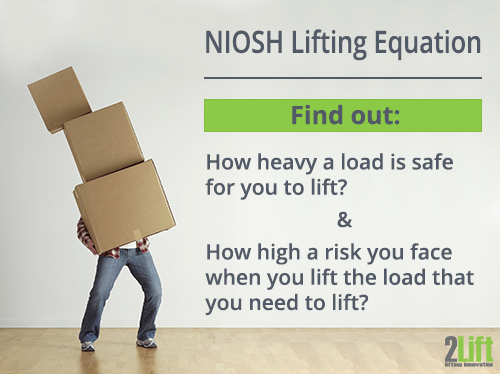
In the EU all member states must be able to publicly present guidelines for performing risk assessment for manual handling. A few countries have chosen to include specific weight limits to the material handling of loads in their national legislation, others have not. Most models built have a basis in the NIOSH Lifting Equation.
The way that each EU country have chosen to work with the Directive and how they have chosen to present it to their national audience is very different from country to country. Some have put a lot of work into building lots of easily accessible and easy-to-understand material for the public, others seemingly not. Member states had until December 31, 1992 to create laws, regulations and administrative provisions needed to comply with the Directive 90/269/EEC.
Implementing the ‘Manual Handling Directive’ Has not Been a Simple Walk in the Park
– MSDs Are Still a Growing Trend in Many Countries

The implementation and enforcement of all these directives for safety and health at work, has not been all that easy, however. Challenges have been especially prominent in the southern parts of Europe.
Broadly speaking, even though employers’ awareness of the necessity of having to abide by the rules for the manual handling of loads and despite the initiative to take preventive measures has risen since the rules were made, the number of workers suffering from back related problems like MSD is not showing a diminishing trend.
In many countries the trend is growing. And rather surprisingly, the number of employees who have to deal with loads manually, is also growing. All this quite opposite to the intention of the directive.
In other words, even though employers know there are rules for lifting, carrying and handling – for some reason, they seem to be not following them. This problem is especially critical in small to medium sized corporations where obligatory risk assessments and proper workers’ training still fail to be carried out.
Investigations of this problem have revealed the four following critical areas with regards to the implementation of the directives (which includes that of the manual handling of loads):
- The information is not specific enough and often considered incomprehensible. Thus it’s not lack of material, it’s the form of the material. Employers simply can’t ‘translate’ the abstract jargon of available documents into practical and applicable knowledge. The margin for interpretation of the material is considered too large.
- It’s a challenge to find the skills required to manage local health and safety.
- There is a lack of resources to ensure sufficient education of staff and leadership parties.
- It’s difficult to get access to specialized and competent technical assistance.
So some of the biggest tasks for the national administrative bodies are to create simple, yet precise material that can be read and understood by everybody, develop simple risk assessment tools, and to find ways to educate employers in how to deal and comply with the directives.
To discover how your country deals with manual handling regulations and to see what kinds of ergonomic risk assessment tools your country has to offer, please scroll down to find your country’s flag and click on it.














NIOSH Lifting Equation
Our Resources on Ergonomics and Manual Handling