

AF – Adjustable Fork:
A Flexible Goods Lift Tool for Lifting Boxes or Pallets
Modern material handling rarely looks the same from one task to the next. From day to day - sometimes even from hour to hour - the types of loads, formats, and workflows can shift completely.

One moment you’re lifting a plastic box that needs to be gently placed on a roller table. The next, it’s a crate with a different footprint. Later still, you might need to pick up a standard pallet, half pallet, quarter pallet or a custom-built trolley that only allows for centre pick-up. These tasks all share a common requirement: a fork that can adapt.
This is where a goods lift with adjustable forks come into play. Whether it’s a standard adjustable model for pallets, boxes, and crates, or a specially designed fork for unique loads, the concept is the same - customised tine spacing for a precise, stable lift.
To further support safe and efficient handling, the adjustable fork can be paired with additional tools on the minilifter. The most common option is the leveling unit - mounted between the lifter and the fork - which keeps the tines perfectly horizontal, even when working on uneven ground or with off-centre loads.
This combination ensures better stability, safer lifting, and more precise load placement across all applications.

Adjusting on the Fly:
- Fork Flexibility at Its Best

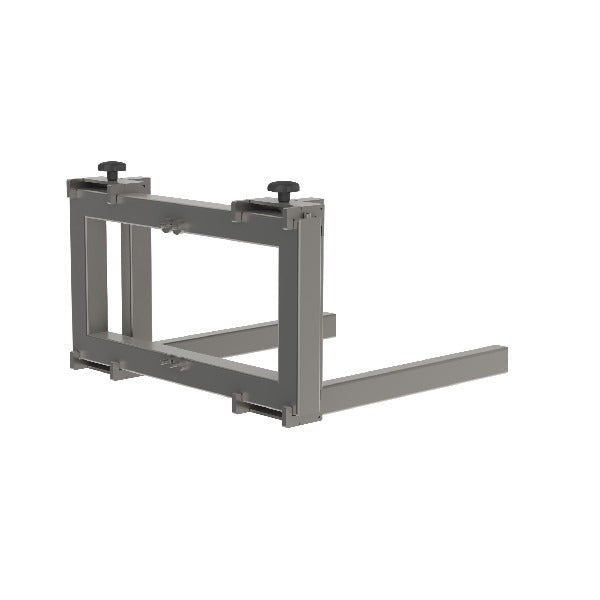
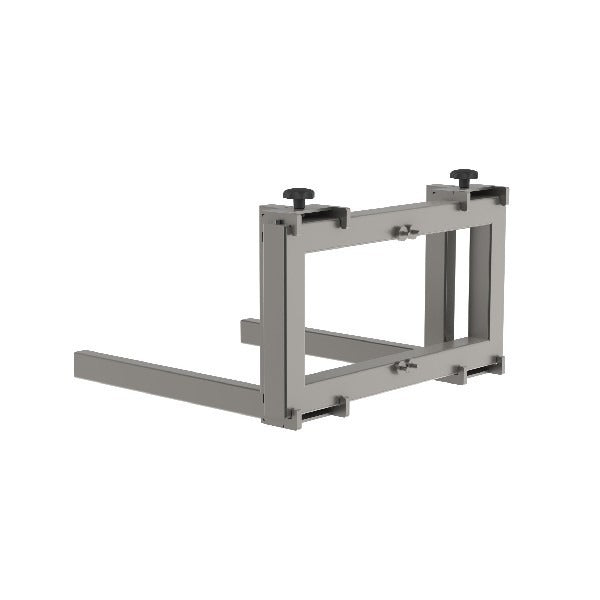
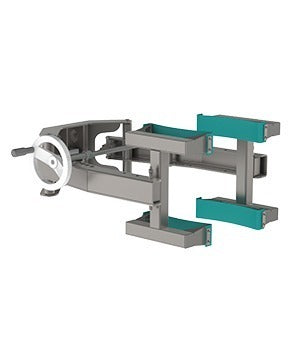
But flexibility isn’t just about what you lift - it’s also about how quickly and easily you can adapt. Mounted on a goods lift, the adjustable fork (AF) allows the tines to slide along a robust rear frame and be securely locked into position using a simple top-mounted knob.
This ensures the tine spacing is always optimal - whether you’re lifting uniform loads, pallets, or dealing with more specialised formats.
And in confined spaces, the ability to pick up a load slightly off-centre can be a real advantage. With the right adjustable fork, you get both safety and flexibility - tailored to the task.
Switch Less, Lift More:
- The Magic of the Adjustable Fork
It’s in everyday use that the adjustable fork truly shows its strengths. As already mentioned it’s not limited to one task or load type - instead, its sliding tines make it a versatile solution for a wide range of lifting needs: from standard pallets and plastic boxes to asymmetrical items and custom-built trolleys.
In the first image series below, we see a straightforward but precise workflow: a the lifter and the white box on a trolley are positioned to prepare for the lifting operation, the tines on the adjustable fork are adjusted to fit right under the edge of the white plastic box, and finally the white box is lifted from the trolley. The tine adjustment ensures the box remains stable throughout - no tool change required.

The second set of examples highlights the range of both standard and customised adjustable forks.
- First, we see red plastic crates being lifted - a straightforward task made efficient by quick tine adjustment to match the crate size.
- Next, a specially designed fork handles a long, cylindrical glass object, demonstrating how custom building can support even delicate or unconventional loads.
- Finally, another custom-built fork is shown, configured specifically for centre pick-up - ideal for handling specialised trolleys where traditional fork setups fall short.
Each scenario showcases the versatility of the adjustable fork concept, whether it's standardised or tailor-made for the job.

And while not pictured here, standard pallets are, of course, part of the equation. The adjustable fork can be quickly configured to lift full pallets, half pallets, quarter pallets, or non-standard formats - making it ideal for mixed operations where load types shift frequently.
In every case, the adjustable fork delivers the same key advantages: safe, stable lifting and true flexibility - all without the need to switch tools.
Precision in Every Degree
- Fine-Tune your Goods Lift with an Electric Leveling Unit (ELU)
Not every load is perfectly placed - and not every handling situation is predictable. That’s where the electric leveling unit (ELU) makes all the difference. Mounted between the minilift and the adjustable fork, the ELU enables precise angular adjustments, ensuring that the fork stays exactly where it needs to be: level or at a slight angle while remaining stable and safe.
There are several situations where this kind of fine-tuned control becomes essential.
- E.g. when picking up a pallet or box positioned at an angle, a flat fork may not slide in cleanly - but a slight tilt ensures smooth entry.
- Also, heavier loads may cause the fork to angle forward slightly once lifted, and the ELU allows you to correct this effortlessly.
- And when docking with machinery or fixed infrastructure, the ability to adjust the fork’s tilts makes for faster, more accurate alignment.
As shown in the image below, the difference may be subtle - but it matters: one moment the fork is slightly angled, the next it's perfectly horizontal. With the ELU, that adjustment takes just seconds. A small feature, perhaps - but one that brings a big improvement in precision, safety, and overall ease of use.

How Exactly Does the Adjustable Fork Work?

The adjustable fork is designed to accommodate loads of varying widths. While the exact dimensions may differ, the adjustment method remains the same.
To reposition the fork tines, begin by loosening the knobs. Carefully slide each tine into the desired position. For optimal balance, try to align the tines so that the load’s centre of mass is positioned centrally on the lifter. Once adjusted, be sure to tighten the knobs securely.
Features
- Independently adjustable fork tines for easy positioning where access is restricted.
- Lockable position – simply turn a knob to lock tines firmly in position.
- Easily customised – The dimensions of the adjustable fork can be modified to customer specifications.
- Rugged construction for industrial use. With its all-stainless steel construction, the AF is built to last and for use in demanding industrial environments.
Specialist Lifting Equipment for Lifting Mixer Lid
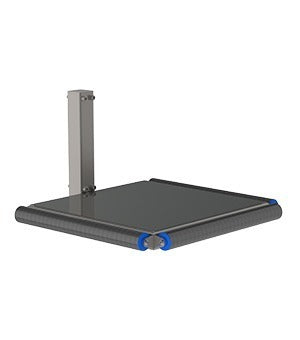
PPR – Plastic Platform with Rollers