

The NIOSH Lifting Equation for Safe Lifting - Are You Lifting too Heavy a Load? Find the Recommended Weight Limit For Your Lifting Task at Work!
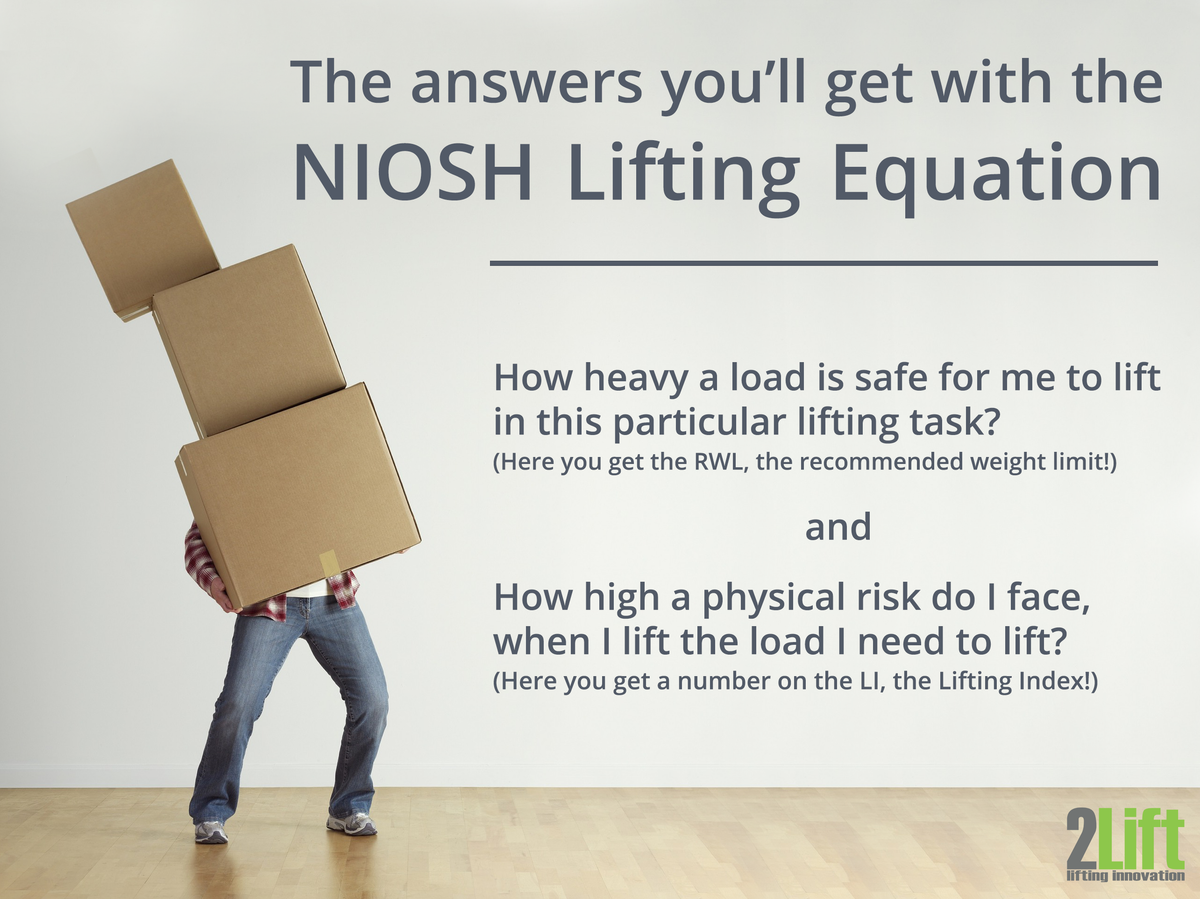
Boiled down to the essence, the NIOSH Lifting Equation for safe lifting can help you answer two questions:
How heavy a load is safe for me to lift in this particular lifting task?
(Here you get the RWL, the Recommended Weight Limit!)
and
How high a physical risk do I face when I lift the load that I need to lift?
(Here you get a number on the LI, the Lifting Index)
Further down this article we’ll explain how you can go about finding the RWL and LI.
First though, we’d like to explain a bit more about the NIOSH Lifting Equation – what characterizes it and how it came about.
What is the NIOSH Lifting Equation?
The NIOSH Lifting Equation is a numeric tool (a clever form of calculator, you could say) that safety and health practitioners can use to evaluate the level of risk associated with a certain type of manual handling action, more specifically the lifting and lowering of loads.
As you are about to discover, the NIOSH Lifting Equation is a rather technical piece of ergonomic risk assessment formula (at least for the common guy, if you’re an engineer, it’s no big deal) because in order to be able to use it correctly, you need to know the specifics of the lifting action in detail, and you shouldn’t be too scared of number crunching either.
Before we get into the lifting equation itself, let’s quickly take a look at how the NIOSH Lifting Equation came about, when it applies and when it doesn’t apply.
The Birth of the Original NIOSH Lifting Equation
The NIOSH Lifting Equation was born in 1981 by NIOSH (The National Institute for Occupational Safety and Health in the U.S.
The purpose of the 1981 NIOSH Lifting Equation was to identify dangerous lifting jobs that could potentially constitute a risk to the musculoskeletal system and thus if ignored, lead to injuries, impairment and / or low back pain (LBP).
What this equation for safe lifting could do was to provide a method for finding safe weight limits for the manual handling of loads. The type of lifting tasks for which it could measure weight limits was fairly simple, namely straight trunk lifting operations known as sagittal lifting tasks.
All this was very well, but the reality of lifting was often more varied and complex, for instance sometimes you’d need to twist the upper body when lifting. Thus the lifting equation was considered too limited as it didn’t embrace enough types of lifting scenarios.
The Revised NIOSH Lifting Equation
Thus 10 years later in 1991, a revised and more comprehensive NIOSH Lifting Equation was developed, and in 1994 this revised edition for safe lifting was made available for use to the general public.
This revised NIOSH Lifting Equation was perceived to be a step up in protecting workers because:
- The maximum recommended load weight had been reduced from 90 pounds (app. 41 kilo) to 51 pounds (app. 23 kilo).
- It applies to a wider variety of lifting operations. The updated equation for safe lifting embraces more lifting variables such as asymmetrical lifting (twisting the trunk) and the quality of hand-holds (the lifting of objects with less than optimal hand gripping possibilities).
However, despite it’s renewed sophistication, the NIOSH Lifting Equation is still only for lifting and not for lifts that include e.g.:
- using only one hand
- work-shifts that last more than 8 hours
- more than minimal carrying / walking (no more than a few steps)
- pushing and / or pulling
- only seated or kneeling positions
- loads considered unstable, e.g. containers with liquid
- more than minimal holding time (no more than a few seconds)
- a high degree of repetitiveness that require significant energy expenditure
- manual handling in ‘poor’ environments e.g. characterized by restricted access, slippery floorings or high / low temperatures
What Exactly Do You Get with the NIOSH Lifting Equation
You get a Recommended Weight Limit (RWL) for:
- a very specific two hand lifting task
- that defines the maximum weight of a load
- that is considered safe to lift for 75% of female workers and 90% of male workers
You also get a number on the Lifting Index (LI) that informs you of the level of risk for MSD (Musculoskeletal Disorders) associated with lifting the load you need to lift. The higher the number, the higher the risk. The goal here is to only have safe lifting tasks with a number score that is less than 1.0.
The NIOSH Lifting Equation Formula
The NIOSH Lifting Equation Formula
Okay, here is the formula for finding the Recommended Weight Limit for your lifting task:
RWL = LC x HM x VM x DM x AM x FM x CM
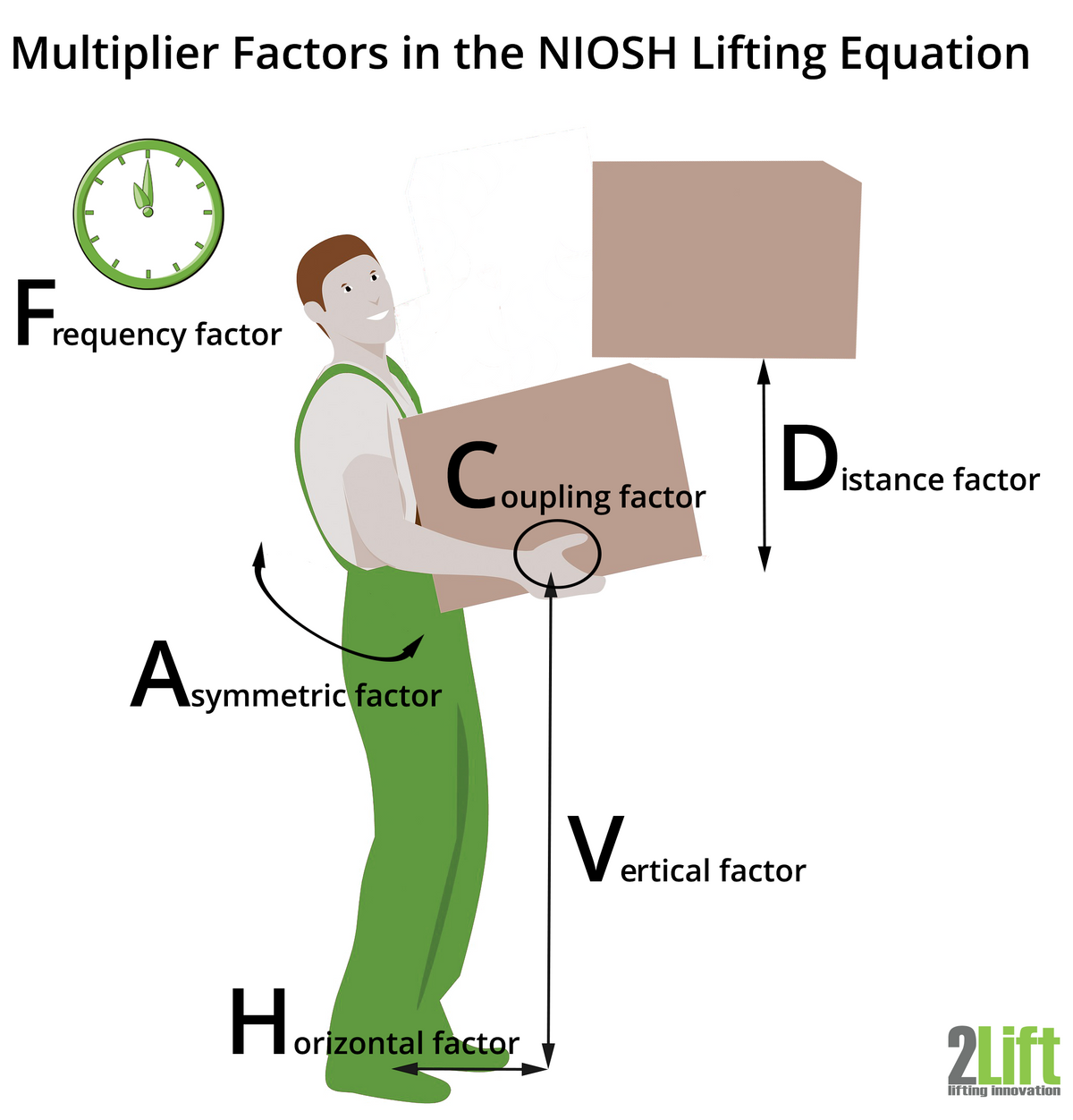
In order to find the Recommended Weight Limit (RWL) you need to know the number of seven different factors pertaining to the lifting operation in question.
The first one, LC (Load Constant) is easy. It’s always the same. It’s 51. 51 pounds (app. 23 kilo) represents the maximum load that can be lifted under ideal circumstances.
All the 6 other factors or variables represent complexities that ‘pull’ the recommended weight of the load down in order to ensure a safe lifting operation.
So what are these 6 other variables?
HM (Horizontal Multiplying factor) = The horizontal distance from hands to the centre of the body (defined as mid-point between ankles).
VM (Vertical Multiplying factor) = The vertical distance between the hands (holding the load in the starting position) and the floor.
DM (Distance Multiplying factor) = The vertical distance the load is lifted, measured from starting point to end point.
AM (Asymmetric Multiplying factor) = The angle of asymmetry to the lift. The degree required to twist the body during the lifting task.
FM (Frequency Multiplying factor) = The time between lifts and the overall duration of lifts during a work-shift.
CM (Coupling Multiplying factor) = The quality of the grasp on the load as defined by ‘good’, ‘fair’ or ‘poor’.
The difficult task here is not so much the measuring as it is to understand exactly what is meant by the variables. If you need more information to be able to decipher some of the variables, Ergo-Plus has a fairly good guide here and The Canadian Centre for Occupational Health and Safety also present more in-depth explanations on the factors here.
Finding the LI
LI = Weight ÷ RWL =
In order to find the LI (Lifting Index) you need to know the weight of the load being lifted and you need the RWL for the lifting task. The LI will give you an indication of the level of risk associated with the lifting task. The higher the LI, the higher the risk of MSD or injuries. Numbers below l.0 are considered safe for most workers.
Ready to Use the Safe Lifting Calculator? Online NIOSH Lifting Equation Calculators to Find the RWL
If you have the above variables for the lifting equations, you are now ready to find the RWL.
There are two ways to go about this:
- You can either press the numbers yourself on a calculator
- Or you can choose to use some online NIOSH Lifting Equation calculators.
Here are some online calculators you can try:
The NIOSH Lifting Equation calculator from The Canadian Centre for Occupational Health and Safety.
The NIOSH Lifting Equation calculator from Ergo-Plus.
If You Feel Like Playing with the Equation! Examples to Help You Understand How the Different Variables May Affect the RWL
If you’re curious to learn more about how the different variables in the lifting equation affect the recommended weight limit, The Canadian Centre for Occupational Health and Safety has made some great examples for you to follow.
Follow the links below to discover:
Other Important Resources
Busy and Want Simpler Calculators?
If the NIOSH Lifting Equation is a bit too data intensive for you, there are several other free safe lifting calculators online, that are both easy and quick to use for busy employer or employee. Se our page on online calculators for more information.
Other Related Pages
An extensive guide to manual handling regulations.
Ergonomic assessment tools for determining risks in relation to lifting, carrying, pushing and pulling loads at work.
Country Specific Pages with Ergonomic Guidelines and Risk Assessment Tools
Quick insights into the main authority (SWA) and the model WHS laws (acts, regulations and code of practices) relevant for manual handling in Australia. Discover your responsibilities as an employer and read about the typical risk factors in lifting, carrying, pushing and pulling operations. Find also links to Australian ergonomic risk assessment tools.
Find to-the-point info on the manual handling authority in Austria, the Labour Inspectorate (die Arbeitsinspektion) and the law for occupational safety and health, the Safety and Protection of Health at Work Act (das ArbeitnehmerInnenschutzgesetz), plus links to ergonomic risk assessment tools for lifting, holding and carrying. See also recommended weight limits for lifting in Austria.
A quick introduction to the main authority for safety and health in Canada, CCOHS and the main employer legislative obligations for manual handling. Also ergonomic guidelines to safe lifting, pushing and pulling and links to risk assessment tools for lifting (CCOHS’ NIOSH lifting equation calculator and the WorkSafe BC lifting calculator).
A brief word on the authority (Arbejdstilsynet) responsible for writing up ergonomic guidelines and for enforcing the manual handling regulations in Denmark. Find also the recommended weight limits for lifting and carrying in Denmark plus guidelines for pushing and pulling loads on wheels.

Easy-to-digest material on the authorities (Ministère du Travail and COCT) and legislations (the French Labour Code and the French Norm NF X35-109) on manual handling in France. Also maximum weight limits for lifting, pushing and pulling and links to simple manual handling risk assessment tools so you can perform your own ergonomic risk analysis at work.

A short introduction to the main occupational safety and health authorities in Germany (NOSHC, BAuA) plus a delineation of employers’ manual handling responsibilities (found in the Lastenhandhabungsverordnung) and insights into the ergonomic risk assessment tool, the Leitmerkmalmethode, for lifting, holding, carrying, pushing and pulling.

Get a quick overview of how the manual handling regulations work in Ireland, the role of HSA, and what you need to do and be aware of as an employer. Find also ergonomic guidelines, a list of risk factors and links to risk assessments tools for lifting, lowering, carrying, pushing and pulling loads at work.

Find to-the-point information on some of the main authorities (e.g. INAIL) in the field of occupational safety and health in Italy. Also insights into the manual handling employer responsibilities, weight limits for lifting at work, and follow links out to ergonomic risk assessment information and tools for lifting and carrying.
Sharp insights into how the legislative system of safety and health works (Arbowet, Arbobesluit, Arboregeling, Inspectie SZW, and the Arbo Catalogue) when it comes to manual handling in the Netherlands. Find relevant links to lifting guidelines and ergonomic tools for risk assessing manual handling operations. Also a presentation of weight limits and other threshold values for lifting.
Insights into the authority (Arbeidstilsynet) managing and the law (Arbeidsmiljøloven) pertaining to manual handling in Norway. Find among other things, ergonomic guidelines and good practices to manually handling loads, weight lifting limits to lifting, pushing and pulling at work and ergonomic risk assessment tools.

Read about the main authority (ACT) responsible for occupational safety and health in Portugal. Get insights into Portuguese law regarding your duties as an employer if manual handling occurs in your workplace and the maximum recommended weight limits for lifting. Find links to ergonomic guidelines for manual handling and correct lifting techniques.

Get insights into the system for occupational safety and health in Spain and read about the main authority, INSSBT, who is responsible for communicating about manuel handling. Learn what your employer responsibilities are and find ergonomic guidelines, risk assessment tools and weight limits for lifting and force limits for pushing and pulling.
Find quick words on the main authority (Arbetsmiljöverket) responsible for communicating and enforcing manual handling regulations in Sweden. Also insights into ergonomic guidelines, risk assessment tools and weight limits for lifting and force limits pushing and pulling loads.

A brief introduction to the relevant authorities in the field of occupational safety and health (Federal Counsel, FCOS, SUVA and SECO) in Switzerland. Also links out to lifting guides and ergonomic risk assessment tools for lifting, holding, carrying, pushing and pulling in both German, French and Italian.
Find UK employer guidelines (e.g. the HSE (Health and Safety Executive) publication: Manual handling. Manual Handling Operations Regulations 1992) on how to comply with the regulations for the manual handling of loads. Also find links to risk assessment tools for lifting, lowering and carrying (MAC tool) as well as pushing and pulling (RAPP tool).
Other Important Pages
Ergonomic Lifting
Go to our page on ergonomic lifting for an overview of rules and regulations worldwide.